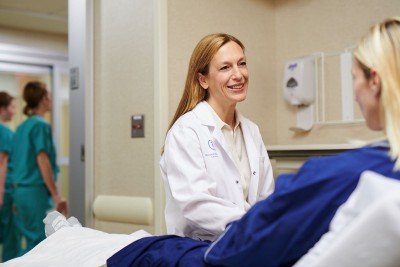
Thoracic surgeon Daniela Molena leads clinical trials to improve outcomes for people with esophageal cancers.
At any time Memorial Sloan Kettering Cancer Center is conducting hundreds of clinical trials to improve care for many types of cancer. Use the tool below to browse our clinical trials that are currently enrolling new patients. Each listing explains the purpose of the trial, the trial’s eligibility criteria, and how to get more information.
The list below includes clinical trials for adult cancers. Please visit our pediatric cancer care section to find a pediatric clinical trial.
The purpose of this study is to see how treatment for retinoblastoma in one eye affects quality of life in survivors of this cancer who had chemotherapy (injected into the eye) or surgery to remove the eye. Researchers will ask participants about their physical and emotional health and ability to perform daily activities. They want to determine if there are any differences between these treatments with respect to their effect on quality of life. It is hoped that this information will help doctors provide better care for children with retinoblastoma in the future and better follow-up care for survivors of this cancer.
The purpose of this study is to evaluate the effectiveness of treating patients with recurrent and newly diagnosed glioblastoma using new therapies that are thought to be effective for treating brain cancer. The new therapies available as part of this clinical trial include regorafenib, VAL-083, and paxalisib.
Patients receiving certain drugs for breast cancer, such as doxorubicin or trastuzumab, may experience impaired heart function. Researchers at Memorial Sloan Kettering Cancer Center are conducting a study to see if it is possible to grow heart muscle cells ("cardiomyocytes") from blood or skin cells from breast cancer patients. The skin cells will be grown in a special mixture in the laboratory designed to transform them from skin cells into heart muscle cells.
Mycosis fungoides (MF) is a disease in which lymphocytes (a type of white blood cell) become cancerous and affect the skin, causing "cutaneous T-cell lymphoma." Lymphomatoid papulosis (LyP) is a rare and similar disorder that causes lymphoma-like skin lesions.
This study is evaluating the safety and effectiveness of combination chemotherapy, surgery, and radiation therapy in children and young adults with newly diagnosed stage II-IV diffuse anaplastic Wilms' tumors (DAWT) or favorable histology Wilms' tumors (FHWT) that have come back (relapsed).
Mycosis fungoides (MF) is a disease in which lymphocytes (a type of white blood cell) become cancerous and affect the skin, causing cutaneous T-cell lymphoma. The drug bexarotene and a very low-dose form of radiation treatment called total skin electron beam (TSEB) radiotherapy are each used individually to treat MF; this study is evaluating the safety of their use together. Researchers think that since bexarotene takes up to three months to relieve symptoms, combining it with TSEB could stabilize or improve MF and reduce symptoms, including itching.
Researchers in this study are assessing the combination of enfortumab vedotin with pembrolizumab immunotherapy in people with bladder cancer that has spread to nearby lymph nodes and will be surgically removed. Both medications are already used to treat bladder cancer, but their use together before surgery is considered investigational. Both drugs help the immune system attack and kill cancer cells. The study investigators will see if this combination treatment can get rid of cancer in the lymph nodes and shrink patients' tumors before surgery.
The purpose of this study is to find the highest dose of the investigational drug PC14586 that can be given in patients with solid tumors that came back or continue to grow despite prior therapy and contain a mutation in the TP53 gene. The p53 protein produced by this gene normally tells cells when to stop dividing, but when TP53 is altered (mutated), cancer may result.
The purpose of this study is to assess the safety and effectiveness of different combinations of drugs to treat advanced clear cell renal cell carcinoma, a type of kidney cancer, in patients who have not received any prior treatment or who have recently developed worsening disease while receiving immunotherapy that targets the PD-1/PD-L1 proteins.