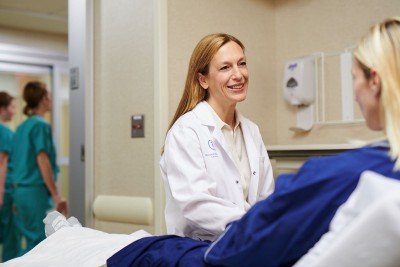
Thoracic surgeon Daniela Molena leads clinical trials to improve outcomes for people with esophageal cancers.
At any time Memorial Sloan Kettering Cancer Center is conducting hundreds of clinical trials to improve care for many types of cancer. Use the tool below to browse our clinical trials that are currently enrolling new patients. Each listing explains the purpose of the trial, the trial’s eligibility criteria, and how to get more information.
The list below includes clinical trials for adult cancers. Please visit our pediatric cancer care section to find a pediatric clinical trial.
The purpose of this study is to find the highest dose of the investigational treatment UCART22 that can be given safely in children and young adults with B-cell acute lymphoblastic leukemia (ALL) that has come back or continued to grow despite treatment. UCART22 is a form of CAR T-cell therapy. It is made from white blood cells (T cells) from healthy donors. The T cells are genetically modified in a laboratory to identify and destroy cancer cells containing a protein called CD22.
This clinical trial explores a novel approach to treating mantle cell lymphoma (MCL). Researchers are integrating targeted agents into standard induction and maintenance chemoimmunotherapy. The people in this study have MCL that has not yet been treated.
Chemotherapy can cause symptoms, such as nausea and fatigue, and some patients have difficulty working during this treatment. The purpose of this study is to learn more about how chemotherapy for breast cancer affects patients' employment.
The purpose of this study is to assess the safety and effectiveness of combining pembrolizumab immunotherapy with standard chemotherapy drugs and autologous stem cell transplantation (ASCT) in patients with Hodgkin lymphoma that has come back or continued to grow despite one regimen of prior therapy. Pembrolizumab blocks PD-1, a protein cancer cells use to evade detection by the immune system, thereby enabling the immune system to find and kill cancer cells.
CAR T-cell therapy is a form of immunotherapy used to treat some adults with lymphoma. The treatment involves utilizing a patient's own T cells and genetically modifying them in the laboratory to recognize a protein on their cancer cells. The modified T cells, known as CAR T cells, are then returned to the patient to find and kill cancerous cells throughout the body.
Researchers want to learn if canakinumab can prevent cancer from developing in people with clonal cytopenia of undetermined significance (CCUS). In CCUS, there is a mutation (change) in one or more of the genes that help blood cells develop. People with CCUS have low levels of certain kinds of blood cells.
This study will compare the effects of different amounts of aerobic exercise on heart and lung (cardiorespiratory) fitness in post-menopausal women who completed treatment for early-stage breast cancer. Researchers will study the effects of different exercise programs on oxygen use, heart pumping ability, lung function, and blood vessel health. Participants will be randomly assigned to one of four groups:
After a stem cell transplant, some patients develop a condition called graft-versus-host disease (GVHD). This occurs when the donor's healthy immune cells see the recipient's normal cells as foreign and begin to attack them.
Researchers are doing this study is to find the highest dose of a new cell therapy for people with leukemia. The people in this study have acute myelogenous leukemia (AML) that keeps growing even after treatment. They will get the new treatment with atezolizumab, an immune-boosting therapy.